
‘So-tai’ (Visiting a grave)
December 2 (Tue), 2025 ‐ March 1 (Sun), 2026
This museum exhibits ukiyo-e woodblock prints published in Osaka in the Edo period. Many of the ukiyo-e prints made in Osaka were portraits of kabuki actors performing in theatres mainly around Dotombori, depicting how they played in what costumes.
The title ‘so-tai’ literally means to remove moss from a gravestone, and by extension it means to visit a grave. Even today it is common to visit a grave of great or famous person in history in order to remember and think of the person. Graveyard is an important place for kabuki actors where they face their ancestors because kabuki actors succeed the professional names of their fathers or masters.
In this feature exhibition, we introduce kabuki actors whose graves or monuments exist in Osaka. Please see the ukiyo-e prints of kabuki actors during life. It would be also good to visit the actor’s grave and think of him. We hope this exhibition will be of help to appreciate ukiyo-e.
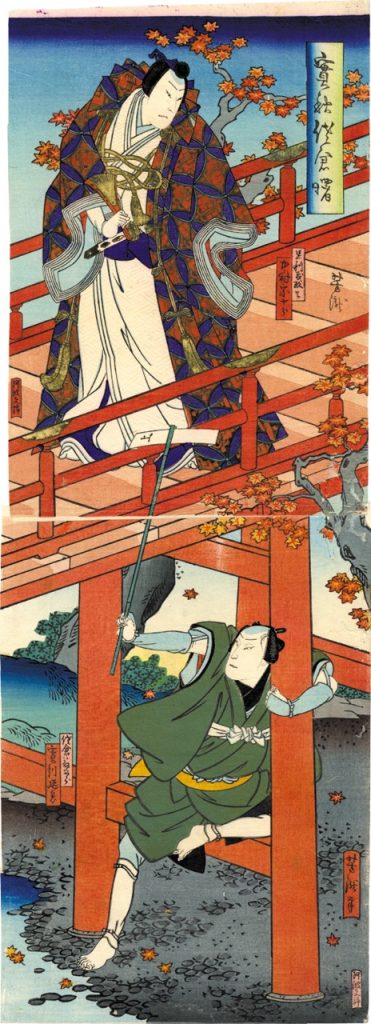
Drawn by Yoshitaki
“Minorino aki sakurano nigiwai”
Performed by Nakamura Sojuro I (playing the role of shogun Ashikaga Yoshimasa), and Jitsukawa Enjaku I (playing the role of Sakura Togoro)
Kabuki actors whose graves are in Osaka
Nichiren-shu, Honkaku-san, Shoho-ji temple
Nakamura Utaemon III was a great actor in kabuki world in Osaka in the Edo period and was depicted in many ukiyo-e prints. His grave is at Shoho-ji temple, his posthumous name and death poem (introduced in the article) and family crest (gionmamori) are engraved on the gravestone.
Nakamura Tamashichi I, Shoho-ji temple
Namamura Tamashichi (actor), died in September, 1910, Nakadera-cho, Shoho-ji temple
Nakamura Tamashichi I died young. In “Kokon haiyu nigao taizen” says ‘Biological son of Nakamura Shikan III died on February 15th, 1860, at the age of 23.’ On the gravestone at Shoho-ji temple the name ‘Kagaya Tamashichi’ is carved.
Multiple posthumous names are printed on the death portraits of Tamashichi, it is unconfirmed whether the grave is his or not.
Nakamura Tomijuro (actor), died on February 13, 1855, at the age of 70, Shoho-ji temple
The grave of Nakamura Tomijuro II was said to have been at Shoho-ji temple but was later enshrined together with other members of the clan by Nakamura Tomijuro V and the gravestone was completely renewed.
NIchiren-shu, Jokoku-ji temple
Nakamura Utaemon (actor), died on February 17, 1852, at the age of 55, Nakadera-cho, Jokoku-ji temple
According to “Naniwa meike boshoki” the grave of Nakamura Utaemon IV is at Jokoku-ji temple, but is now at Jokoku-ji temple (different temple).
Chikamatsu Monzaemon, Homyo-ji temple
Chikamatsu Monzaemon (dramatist of joruri), died on November 22, 1724, at the age of 72, Tanimachiteramachi, Homyo-ji temple
Homyo-ji temple was relocated to Daito city, and the grave of Chikamatsu Monzaemon is currently relocated to Tanimachi. His grave is also at Kosai-ji temple in Amagasaki city, Hyogo.
Graves of characters in kabuki plays
Plays such as “Sonezaki shinju” (based on the real double suicides incident) and “Kanadehon chushingura” (based on the retaliation incident by 47 Ako samurais) dramatized real incidents in perfect timing and became very popular. But dramatizing real incidents could be banned because of the negative influence they might have to the society. When the play was considered to lead to the criticism of the shogunate, the historical background was changed.
But even if the play’s background and names were changed, for the audience it was obvious who was the character’s actual model. Visiting the model’s grave is also the act of ‘so-tai’. Visiting the locations related to the play is also called ‘so-tai’, leading to current ‘visiting real-life anime locations’
Enjo brothers, Sozen-ji temple
Based on the real incident that occurred in 1715 at Sozen-ji temple. Enjo Jizaemon and Harufuji Ikuhachiro, brothers whose youngest brother was killed by Ikuta Denpachi, seek revenge at riding ground in Sozen-ji temple, but on the contrary they were beaten by the enemy who gathered many backers. Graves of Enjo Jizaemon and Ando Kihachiro, brothers and warriors of Yamato Koriyama, are still at Sozen-ji temple.
Sankatsu Hanshici, Mitsu-tera temple
Based on the real double suicide incident occurred at a place commonly called ‘Saitara batake’ at the south of graveyard in Osaka Sennichi in 1695. The model people are said to be Minoya Michikatsu and Akaneya Hanshichi.
This incident was dramatized in 1702. The play got very popular and their memorial tombstone was built near ‘Saitara batake’ and was later restored. The tombstone is now at the Shorinan graveyard in Mitsu-tera temple.
Karigane Bunshichi, Shoho-ji temple
Based on the five rogues actually existed in the Genroku era (1688-1704). The names are Karigane Bunshichi, the head, Anno Heibei, Hoteino Ichiemon, Gokuin Senemon and Kaminarino Shokuro. They were executed at Osaka Sennichi execution site in 1702. “Karigane five men” series were dramatized based on the five rogues, later they came to be described as men of chivalrous spirit rather than mere villains.
The surfaces of graves of Karigane Bunshichi and Gokuin Senemon were peeled off. It is said that people who want to be like them took the piece home.
Wankyu, Jisso-ji temple
Wanya Kyuemon, wealthy merchant in Osaka, got obsessed with courtesan Matsuyama in Shinmachi red light district. He lived it up extravagantly so his relatives confined him in a room. Then he went insane and died in 1677. A play and dance were created based on this true story.
In “Naniwa meike boshoki”, says ‘Wankyu, died in September 7, 1677, Teramachi 8 chome, Jisso-ji temple. On the surface of his gravestone the name Sotatsu koji is carved and on the different part of the stone the word ‘Wankyu’s grave’ is carved.’ There is Matsuyama’s grave next to Wankyu’s grave at Jisso-ji temple.
Death portrait; ukiyo-e that mourn the dead
Creating a death portrait by which people remember the dead and think of his life as an actor might be similar to do ‘so-tai’.