
Tale of Dotonbori in ukiyo-e
March 3 (Tue) ‐May 31 (Sun), 2026
Kamigata ukiyoe museum opened on April 28th in 2001 as a museum that exhibits ukiyoe woodblock prints published in Osaka in the Edo period. Osaka ukiyoe mainly depict kabuki actors playing in theaters in Dotonbori area. Ukiyoe describe how the kabuki plays were like at the time.
It has been 25 years since the opening of the museum and the feature exhibitions are almost going to be 100th. This museum is close to Dotonbori that has flourished since the Edo period as a theater district. Many people including fans of kabuki and ukiyoe visit here as it stands at a place associated with kamigata ukiyoe.
In this feature exhibition, we introduce themes and episodes of our exhibitions over the past 25 years, focusing ukiyoe related to Dotonbori. We would appreciate it if this exhibition conveys the memories of the theater district since the Edo period, as culture of kabuki play is fading away from Dotonbori.
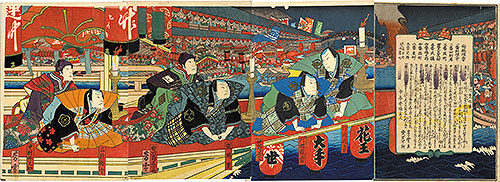
Drawn by Yoshiyuki
“Kawatake norikomi nigiwai”
Theaters in Dotonbori
In the Edo period Yasui Doton began excavating Dotonbori canal using his own money and Doboku, Doton’s cousin, completed the project. The canal was named Dotonbori (Doton’s canal). In 1652 (Jouou 1), the right to Dotonbori stage performances was enacted. Theaters including Nakaza and Kadoza were brought together in one area which developed as ‘theater district’.
We have introduced lively atmosphere at Dotonbori as a theater district through exhibitions we have held since its opening. In particular, two big kabuki theaters, Nakano shibai (9th feature exhibition) and Kadono shibai (32nd feature exhibition), are among our most important themes of feature exhibitions.
In the 80th feature exhibition ‘Osaka theaters map’, we introduced the fact that there were smaller theaters such as ‘Naka shibai’ and ‘Hama shibai’ in Osaka which gave kabuki performances also at Kita shinchi or Horie, other than Dotonbori as an inexpensive and casual entertainment.
Relationship with Osaka Shochikuza Theater
Osaka Shochikuza Theater opened in 1923 (Taisho 12) as the first authentic western-style theater in Osaka. It hosted musical performance revues of Shochiku Rakugekibu (later OSK Nippon Revue Company), kabuki plays and other various stage performances and also was used as a movie theater. It survived an Osaka air raid during WWII. As you may already know, the theater is bustling with people after renewed and reopened after ‘big Heisei renovation’.
Here we introduce relationship of our ukiyoe and the theater and regret the closing of it in May 2026.
“Igagoe norikake gappa”
This ukiyoe was introduced as a reference ukiyoe at kabuki performance “Igagoe dochu sugoroku Numazu” in July 2023.
“Kawafune no tsuki”
This ukiyoe was used as a front cover of the program for kabuki performance in July 2021.
“Natsumatsuri naniwakagami”
This ukiyoe was used as a front cover of the program for kabuki triumphant return performance from the U.S. in October 2004.
“Sannin banzai shintamafude”
This ukiyoe was used as a front cover of the program for new year kabuki performance in January 2005.
Kabuki actors performing in Dotonbori theaters
Popular kabuki actors who played in Dotonbori theaters were often depicted in kamigata ukiyoe. In the past, we focused on kabuki actors who were portrayed in kamigata ukiyoe, including the 7th feature exhibition ‘World of Nakamura Utaemon III’. In particular we have repeatedly focused on clan members of Nakamura Utaemon III such as the 26th exhibition ‘Portraits of Ichikawa Ebijuro I’, the 42nd ‘Nakamura Utaemon IV’, and the 35th ‘Nakamura Tomijuro II’. They are portrayed many times in ukiyoe.
The 70th exhibition focused on Jitsukawa family who were active at the end of the Edo period and the 58th exhibition focused on Onoe Tamizo who continued to be popular after the Meiji Restoration. We also focused on kabuki actors from Edo area, showing that there were many popular kabuki actors performing in Dotonbori theaters.
Ukiyoe related to Dotonbori
In the Edo period, theaters were compulsorily gathered in Dotonbori. Teahouses were opened and actors’ houses were built around Dotonbori and along with theaters they formed a large theater district. Ukiyoe depicts a turret raised as the symbol of official permission and bonten, a large fabric object as a dwelling place for god, is also put alongside a turret. It seems like we can hear music and hustle and bustle just looking at ukiyoe.
Most of kamigata ukiyoe are portraits of kabuki actors and there are not many ukiyoe that depict Dotonbori scenery. But Dotonbori kabuki was tourist attraction in Osaka, so the scenery was often drawn as background of kabuki actors. Here we introduce ukiyoe that depicts bustle in Dotonbori. We hope you imagine the scenery at the time.
“Chotto ippuku eeasobi: Entertainments in Kyoto and Osaka in the Edo period”
Exhibited in ‘study tour at museum’ exhibition at Ryukoku University in December 2025. We cooperated with students who came to learn and report on theater district in Dotonbori and their exhibition of ukiyoe.
Conclusion
Thanks to you all we now celebrate 25th anniversary. We would like to express again our deepest gratitude to all concerned. Also we thank you all visitors to this museum. We continue to hold feature exhibitions to convey the museum’s charm and ask for your continued support.